Thursday, September 29, 2011

What is an ecosystem?


An ecosystem consists of the biological community that occurs in some locale, and the physical and chemical factors that make up its non-living or abiotic environment. There are many examples of ecosystems -- a pond, a forest, an estuary, a grassland. The boundaries are not fixed in any objective way, although sometimes they seem obvious, as with the shoreline of a small pond. Usually the boundaries of an ecosystem are chosen for practical reasons having to do with the goals of the particular study.


Which ecosystem do you have?
http://www.globalchange.umich.edu/globalchange1/current/lectures/kling/ecosystem/ecosystem.html

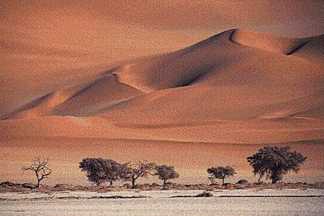
Desert ecosystem


Deserts cover about one fifth of the Earth's land surface. Most Hot and Dry Deserts are near the Tropic of Cancer or the Tropic of Capricorn. Cold Deserts are near the Arctic part of the world.The precipitation in Hot and Dry Deserts and the precipitation in Cold Deserts is different. Hot and Dry Deserts usually have very little rainfall and/or concentrated rainfall in short periods between long rainless periods. This averages out to under 15 cm a year. Cold Deserts usually have lots of snow. They also have rain around spring. This averages out to 15 - 26 cm a year.Hot and Dry Deserts animals include small nocturnal (only active at night) carnivores. There are also insects, arachnids, reptiles, and birds. Some examples of these animals are Borrowers, Mourning Wheatears, and Horned Vipers. Cold Deserts have animals like Antelope, Ground Squirrels, Jack Rabbits, and Kangaroo Rats.


Did you ever think all the deserts were that big?
http://www.blueplanetbiomes.org/desert.htm

Two real life deserts


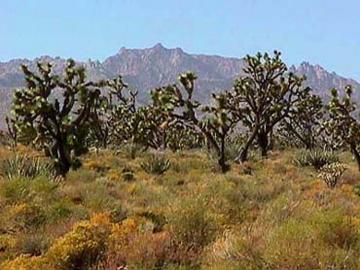
 The Mojave Desert is special because it has a little bit of everything. People refer to the Mojave Desert as a "high desert" because it has an elevation of 2,000 to 5,000 feet. It changes from a cold desert in the northern section and a hot desert in the southern section. The Mojave Desert covers 25,000 square miles. There are some fascinating features to be found in this desert, especially the Kelso Dunes. The Kelso Dunes are the largest of the Mojave dune fields, reaching 500 to 600 feet in height. When you run down these dunes you can hear an unusual "barking" sound. It is not entirely understood yet but some people believe that grains of quartz and feldspar rubbing against each other cause it.


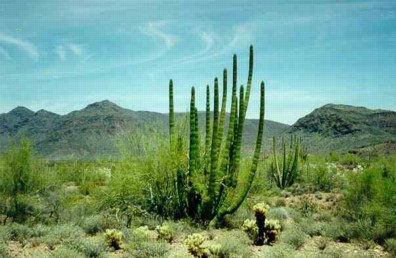
The key to the Sonoran Desert's climate is the amount of rainfall which falls. More rain falls on the Sonoran Desert than any other desert. When it does get rain, the desert is damp, and the air is cool. When it has no rain the desert is really dry and really hot. When the desert is windy, the sand gets picked up and tossed around which creates a sand storm or if the wind is blowing in a certain kind of way, it creates a whirlwind or dust devil. These mini-tornados move across the desert floor and they most often occur in hot weather. The desert valley is hot while up in the mountains it is cool and some mountains are even snow covered. 


 Which desert would you choose?
http://www.blueplanetbiomes.org/desert.htm

Things you could find in the desert


The desert is dry, barren, hot, and silent. Not a drop of water for months. If the desert is so hostile, then how can living things survive? There are two main types of desert in the world-the hot desert and the semi-desert. The hot desert is usually near the equator. A hot desert is usually the sandy-Egyptian type of desert. The semi-desert looks like a scrubland. The semi-desert is the one you usually see on westerns.

Which desert type would you choose?
http://ths.sps.lane.edu/biomes/desert4/desert4.html

Tuesday, September 27, 2011

Second porducer of my ecosystem

Carnivores are predators and chiefly eat meat, although some will consume plants. They will drink water when it is available, but are not dependent on it since the moisture-rich flesh of their prey satisfies their water needs. This group includes such well known members as the coyote, kit fox, gray fox, bobcat and mountain lion.

Did you ever think carnivores would eat plants?
http://digital-desert.com/wildlife/mountain-lion.html

Producers of the Desert biome

Plants play the most important part in the cycle of nature. Without plants, there could be no life on Earth. They are the primary producers that sustain all other life forms. This is so because plants are the only organisms that can make their own food. Animals, incapable of making their own food, depend directly or indirectly on plants for their supply of food. All animals and the foods they eat can be traced back to plants.


Ever think the desert would grow these plants?
http://www.blueplanetbiomes.org/plants.htm

mid-level

The Mojave rattlesnake is widely distributed throughout the Mojave and extreme northern Colorado deserts. It is found from 150 to 1500m in elevation in most desert habitats, especially desert cactus scrub, desert wash, and Joshua tree, and is most common in association with creosote. It seems to prefer desert flats over hilly or canyon habitat. This species is active from April until September.


What would you do if this came across your path?
http://digital-desert.com/wildlife/mojave-green-rattlesnake.html

Monday, September 26, 2011

Mountain Lion


Mountain Lion
Mule deer make up 60-80% of diet throughout year. Also eat rabbits and hares, rodents, porcupines, skunks, coyotes, and, occasionally, domestic stock. Grouse, turkey, fish, insects, grass, and berries also have been reported in the diet. Usually stalk prey on ground, often locating by scent. Kill larger prey by stalking within a few meters, and then leaping onto it and biting at base of skull.


Would you like the mountain lion as a pet?
http://digital-desert.com/wildlife/mountain-lion.html

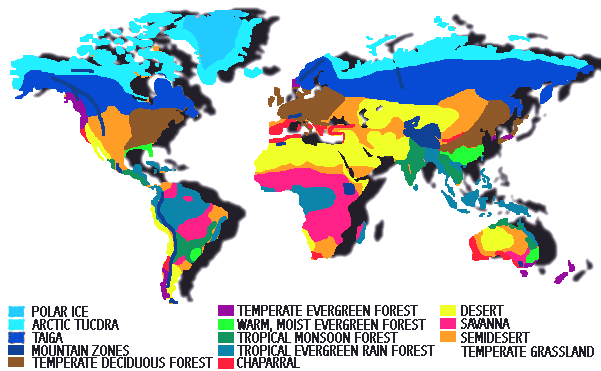
Locations of desert biomes around the world.

This map shows the locations of all the desert biomes around the world. Deserts cover about one fifth of the Earth's surface and occur where rainfall is less than 50 cm/year. Although most deserts, such as the Sahara of North Africa and the deserts of the southwestern U.S., Mexico, and Australia, occur at low latitudes, another kind of desert, cold deserts, occur in the basin and range area of Utah and Nevada and in parts of western Asia. Most deserts have a considerable amount of specialized vegetation, as well as specialized vertebrate and invertebrate animals. Soils often have abundant nutrients because they need only water to become very productive and have little or no organic matter. Disturbances are common in the form of occasional fires or cold weather, and sudden, infrequent, but intense rains that cause flooding.

Would you like to spend a couple of days in the desert?
http://www.ucmp.berkeley.edu/exhibits/biomes/deserts.php